Labels

Tampilkan postingan dengan label Adaktif. Tampilkan semua postingan

Rabu, 28 November 2012

earth


Earth is the third planet from the eight planets in the Solar System. Estimated to reach 4.6 billion year age. The distance between the Earth to the Sun is 149.6 million kilometers or 1 AU (English: Astronomical Unit). At the Earth's rotation is 23 hours 56 minutes 4 seconds. While at the time of revolution is 365.25 days. Earth has a layer of air (atmosphere) and the so-called magnetic field (magnetosphere) that protect Earth's surface from the solar wind, ultraviolet light and radiation from space. This air layer surrounds the Earth to a height of about 700 kilometers. The air layer is divided into Troposphere, stratosphere, mesosphere, thermosphere and exosphere.
The ozone layer, as high as 50 kilometers, are in the stratosphere and mesosphere and protects the Earth from ultraviolet rays. The difference in the surface temperature of the Earth is between -70 ° C to 55 ° C depending on the local climate. The day is divided into 24 hours, and a year on Earth equal to 365.2425 days. Earth has a mass weighing 59 760 billion tons, with a surface area of ​​510 million square kilometers. The density of the Earth (about 5,500 kilograms per cubic meter) is used as a unit of weight ratio of any other type of planet, the gravity of the Earth is set as 1.
The Earth has a diameter of 12,756 kilometers long. Earth's gravity is measured as 10 N kg-1 be a unit of measure of the gravity of other planets, the Earth's gravity is set as 1. Earth has one natural satellite is the moon. 70.8% of Earth's surface covered with water. Earth Air consists of 78% nitrogen, 21% oxygen and 1% water vapor, carbon dioxide and other gases.
Earth estimated to be made up in the Earth's core consists of iron-nickel-thick frozen 1370 kilometers with temperatures 4500 ° C, is also covered by a liquid outer core that is 2100 kilometers thick, and covered also by the 2800 kilometer-thick mantle of silica forming 83% content of the Earth and eventually completely covered by the Earth's crust about 85 kilometers thick.
Thinner crust on the ocean floor is about 5 kilometers. Earth's crust is divided to several parts and moving through the movement of tectonic plates (the theory of continental drift) that produce earthquakes.
The highest point on Earth's surface as high as Mount Everest is 8,848 meters and the deepest point is the Mariana trench in the Pacific with a depth of 10,924 meters. Lake Baikal is the deepest lake with a depth of 1637 meters, the largest lake is the Caspian Sea with an area of ​​394,299 km2.

Coal-forming material


Almost all of the coal-forming plants. The types of plants and coal-forming age by Diessel (1981) are as follows:
-Algae, from Pre-Cambrian Times to the Ordovician and single-celled. Very few coal deposit of this period.
-Silofita, from the Silurian Period to the Middle Devon, is derived from algae. Few coal deposit of this   
 period.
-Pteridofita, age of Upper Devonian to Upper Carboniferous. The main coal-forming material from Carbon  
 in Europe and North America. Plants without flowers and seeds, spores multiply and grow in warm 
 climates.
-Gimnospermae, a period ranging from Permian to Cretaceous Middle Ages. Heterosexual plants, seeds  
 encased in fruit, such as pine, contain high levels of sap (resin) high. Type Pteridospermae like  
 gangamopteris and Glossopteris is the main constituent Permian coal as in Australia, India and Africa.
-Angiosperms, from the Upper Cretaceous period until now. Modern plants, the fruit covering the seeds, the  
 male and female in one flower, less gummy than gimnospermae so that, in general, less well preserved.

The formation of acid rain

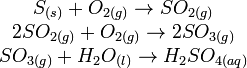
In simple terms, acid rain formation reaction as follows:

\begin{matrix}
S_{(s)}+O_{2(g)}\rightarrow SO_{2(g)} \\
2 SO_{2(g)}+O_{2(g)}\rightarrow 2 SO_{3(g)} \\
SO_{3(g)} +H_2O_{(l)}\rightarrow H_2SO_{4(aq)}\\
\end{matrix}


Evidence of an increase in acid rain derived from the analysis of polar ice. Looks pH levels to drop since the start of the Industrial Revolution from 6 to 4.5 or 4. Other information obtained from organisms known as diatoms which inhabit ponds. After many years, the dead organisms will settle in layers of sediment in the bottom of the pool. Diatom growth will increase at a certain pH, so the number of diatoms found in the bottom of the pool will show the pH changes on an annual basis when we look into each of these layers.

Since the start of the Industrial Revolution, the amount of emissions of sulfur dioxide and nitrogen oxides into the atmosphere is increasing. Industries that use fossil fuels, especially coal, a major source of sulfur oxides is increasing. PH readings in industrial areas are sometimes recorded up to 2.4 (the acidity of vinegar). These sources, plus the transportation, are major contributors to acid rain.

The problem of acid rain not only increased in line with population growth and industrial but has evolved to become more widespread. The use of a high chimney to reduce local pollution contribute to the spread of acid rain, due to the release of greenhouse gas emissions will go to the regional air circulation which have greater reach. Often, acid rain occurs in areas far from the source, where the mountainous regions tend to earn more because of high rainfall here.

There is a close relationship between low pH with decreasing fish populations in lakes. pH below 4.5 is not possible for fish to live, while pH 6 or higher will help the growth of the fish population. Acid in the water will inhibit the enzyme production of trout larvae to come out of their eggs. Acid also bind toxic metals in the lake are like aluminum. Aluminum will cause some fish secrete excessive mucus around the gills so that the fish could hardly breathe. Phytoplankton growth is the source of fish food is also inhibited by high pH levels.

Plants affected by acid rain in various ways. Waxy coating on the leaves is broken so that the nutrients disappear so the plants are not resistant to the cold, fungi and insects. Root growth slows so fewer nutrients that can be taken, and essential minerals to be lost.

The ions are separated due to toxic acid rain became a major threat to humans. Copper in water affects outbreaks of diarrhea in children and aluminum contaminated water can cause Alzheimer's disease.

The greenhouse effect


All energy sources that exist on Earth comes from the Sun. Most of the energy in the form of short-wave radiation, including visible light. When this energy is reached the Earth's surface, it changes from light into heat that warms the Earth. The earth's surface will absorb some of the heat and reflect the rest. Some of this heat is tangible long-wave infrared radiation into space. However, most of the heat remains trapped in the Earth's atmosphere due to accumulated amount of greenhouse gases include water vapor, carbon dioxide, sulfur dioxide and methane into the trap wave radiation. These gases absorb and reflect radiation emitted by the Earth and consequently heat will be stored on the surface of the Earth. This situation occurs continuously, resulting in an annual average temperature of the earth continues to rise.
These gases may act as a greenhouse gas. With increasing concentrations of these gases in the atmosphere, the more heat is trapped beneath it.
The greenhouse effect is needed by all living things on earth, because without it, the planet would be very cool. With an average temperature of 15 ° C (59 ° F), the earth actually had more hot 33 ° C (59 ° F) from the original temperature, if there is no greenhouse effect of the earth's temperature is only -18 ° C so that the ice will cover the entire the Earth's surface. However, on the contrary, if these gases in the atmosphere has been excessive, will cause global warming.

Selasa, 27 November 2012

Newton's laws of motion

Newton's laws of motion are three physical laws that form the basis of classical mechanics. This law describes the relationship between the forces acting on an object and the motion they produce. This law has been written with a different pembahasaan for nearly three centuries, and can be summarized as follows:

First Law: Every object will have a constant velocity unless a non-zero resultant force acting on the object. Meaning if the resultant force is zero, then the center of mass of an object remains at rest or moving at a constant speed (not accelerating).
Second Law: A body of mass M having the resultant force of F will accelerate a direction similar to the direction of the force, and the magnitude is proportional to F and inversely proportional to M. or F = Ma. It could also mean the resultant force acting on an object is equal to the derivative of the linear momentum of the object with respect to time.
Third Law: action and reaction force of two objects have the same magnitude, the direction reversed, and the line. This means that if an object A, which gives a force of F on object B, then object B will give a force of-F to object A. F and-F have the same magnitude but different direction. This law is also known as the action-reaction law, with F called the action and-F is a reaction.

The three laws of motion was first summarized by Isaac Newton in his Philosophiae Naturalis Principia Mathematica, first published on July 5, 1687. Newton used his work to explain and investigate the motion of a variety of physical objects and systems. For example, in the third volume of the text, Newton showed that the laws of motion combines with the general law of gravity, he can explain Kepler's laws of planetary movements belong.

Electrostatic Discharge

The history begins with the observed electrical amber or resin material which in Greek means the electrons, which if the material is rubbed with a furry animal skin will be able to draw objects subtle light after sticking to it and refuse. The nature of such apparently transmitted to other objects disinggungkan or attached to it, which is why the object was then said to be charged "keambaran" or resinious. The same thing apparently happened with glass rubbed with silk cloth, which makes the transmission of other objects attached to it charged "kekacaan" or vitrious. In 1733, Francois du Fay discovered the fact that in nature there are only two types of cargo, that is cargo resinious and vitrious, and the two objects are the same charge will repel and opposite two objects attract each other if the charges do not. Then Benjamin Franklin (1706-1790) found that the two types of cargo and vitrious resinious that when combined will cancel each other out as well as positive and negative numbers. Since then charge resinious called a negative electrical charge and vitrious called with a positive electrical charge. Continuing the Michelson and Carlisle of electrolysis, Michael Faraday (1791-1867) in 1883 suggested terkuantisasinya electrical charge to units of cargo, which by Stoney in 1874, powered by JJ Thomson in 1897, hypothesized the existence of particles unit electric charge carriers are then called elekron. As the resin, the electron is said to produce a negative electrical charge then elektronpun be electrically charged negative.

Coulomb law

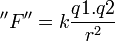
Although J.C. Maxwell (1831-1879) managed to integrate all electrical laws and formulas in the form of four equations were then known as maxwell equations such that all phenomena can be explained by electrical always or translated from the fourth equation, essentially four equations that can be integrated into or can be translated of Coulomb's law:
''F''= k\dfrac{q1.q2}{r^2}
namely that states that the force between two electric charges q1 and q2 will be proportional to the number of electric charges respectively, and inversely proportional to the square of the distance (r) between two electrical charges, as well as depending on the medium in which it is the second charge, that the formulation set medium by a constant k. So Coulomb's law is a fundamental law in the science of electricity, which underlies all applicable laws and electrical formulas, as well as law 'initials Newton mechanics underlying the laws and formulas mechanics. In the mks system of units, medium constants k inscribed as 1 / (4 π ε), so that a form of Coulomb's law:
''F''=\dfrac{q1.q2}{4 \pi \epsilon r^2} 
and ε is called the permittivity of the medium. With positive F means force that repel and opposite negative F means of attraction.

Law of Conservation of Momentum

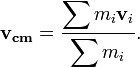
Just like energy, under certain conditions, the momentum of a system will be eternal or unchanging. To provide an understanding of it, it will use the concept of mass center. For example if there is a system consisting of multiple objects with a mass moving with velocity, respectively, then the speed of the center of mass of the system are:
\mathbf{v_{cm}} = { \displaystyle\sum m_i \mathbf{v}_i \over \displaystyle\sum m_i }.
And if the system is moving with accelerated with the acceleration, respectively, then the acceleration of the center of mass of the system are:
\mathbf{a_{cm}} = { \displaystyle\sum m_i \mathbf{a}_i \over \displaystyle\sum m_i }.
Now if the objects are each assigned a style, then these objects each have acceleration:
\mathbf{a_{i}} = { \mathbf{F_i} \over m_i }.
So the acceleration of the center of mass of the system can be expressed as:
\mathbf{a_{cm}} = { \displaystyle\sum \mathbf{F}_i \over \displaystyle\sum m_i }.
Notasi \displaystyle\sum \mathbf{F}_i. a notation stating the resultant force acting on the system. If the resultant force acting on the system is zero (\displaystyle\sum \mathbf{F}_i = 0),then the system is not accelerated (\displaystyle\sum \mathbf{a}_i = 0). If the system is not accelerating, it means the system is the speed of the center of mass of the system is constant (\mathbf{v_{cm}} = constant).So it can be concluded that:
\displaystyle\sum m_i \mathbf{v}_i = constant.
The notation above is a notation of the law of conservation of momentum. So the total momentum of a system is always conserved only if the resultant force acting on the system is zero.

Senin, 26 November 2012

quantum chemistry

Quantum chemistry mathematically describes the fundamental behavior of matter at the molecular level. In principle, it is possible to describe all chemical systems using this theory. In practice, only the simplest chemical systems may realistically be investigated in purely quantum mechanical terms, and approximations must be made for most practical purposes (eg, Hartree-Fock, post-Hartree-Fock or density functional theory, see computational chemistry for more details) . Therefore, understanding of quantum mechanics is not necessary for most chemistry, as the important implications of the theory (principally the orbital approximation) can be understood and applied in simpler terms.

In quantum mechanics (several applications in computational chemistry and quantum chemistry), Hamiltonian, or physical, of a particle can be expressed as the sum of two operators, one associated with the kinetic energy and the potential energy. Hamiltonian in the Schrödinger wave equation used in quantum chemistry has no terminology for electrons round.

Completion of the Schrödinger equation for the hydrogen atom gives the shape of the wave function for the atomic orbitals, and the relative energies of the 1s, 2s, 2p and 3p. Orbital approximation can be used to understand other atoms such as helium, lithium, and carbon.

The chemical reaction

A chemical reaction is a transformation / alteration in the molecular structure. These reactions can result in molecules to form larger molecules, molecules into two or more smaller molecules, or penataulangan atoms in the molecule. Chemical reactions usually involve the making or breaking of chemical bonds.

States of matter

Phase is a collection of state of a macroscopic physical system that is relatively serbasama both their chemical composition and properties of physical properties (eg density, crystal structure, index of refraction, and so forth). Examples of phases that we know is a solid, liquid, and gas. Less familiar phases include plasmas, Bose-Einstein condensation, and condensation Fermions. State phase of the magnetic material is paramagnetic and ferromagnetic.

chemical bonds

Chemical bond is the force that holds the gathering of atoms in a molecule or crystal. In many simple compounds, valence bond theory and the concept of oxidation number can be used to predict molecular structure and composition. Similarly, theories from classical physics can be used to predict many ionic structures. In more complex compounds / complicated, such as metal complexes, valence bond theory can not be used due to a deeper understanding are necessary on the basis of quantum mechanics.

Minggu, 25 November 2012

Primary production

Primary production is the production of organic matter from inorganic carbon sources. Overwhelmingly, this occurs through photosynthesis. The energy incorporated through this process supports life on earth, while the carbon makes up much of the organic matter in living and dead biomass, soil carbon and fossil fuels. It also drives the carbon cycle, which influences global climate via the greenhouse effect.

Through the process of photosynthesis, plants capture energy from light and use it to combine carbon dioxide and water to produce carbohydrates and oxygen. The photosynthesis carried out by all the plants in an ecosystem is called the gross primary production (GPP). About 48–60% of the GPP is consumed in plant respiration. The remainder, that portion of GPP that is not used up by respiration, is known as the net primary production (NPP). Total photosynthesis is limited by a range of environmental factors. These include the amount of light available, the amount of leaf area a plant has to capture light (shading by other plants is a major limitation of photosynthesis), rate at which carbon dioxide can be supplied to the chloroplasts to support photosynthesis, the availability of water, and the availability of suitable temperatures for carrying out photosynthesis.

Ecosystem processes

Energy and carbon enter ecosystems through photosynthesis, are incorporated into living tissue, transferred to other organisms that feed on the living and dead plant matter, and eventually released through respiration. Most mineral nutrients, on the other hand, are recycled within ecosystems.

Ecosystems are controlled both by external and internal factors. External factors, also called state factors, control the overall structure of an ecosystem and the way things work within it, but are not themselves influenced by the ecosystem. The most important of these is climate. Climate determines the biome in which the ecosystem is embedded. Rainfall patterns and temperature seasonality determine the amount of water available to the ecosystem and the supply of energy available (by influencing photosynthesis). Parent material, the underlying geological material that gives rise to soils, determines the nature of the soils present, and influences the supply of mineral nutrients. Topography also controls ecosystem processes by affecting things like microclimate, soil development and the movement of water through a system. This may be the difference between the ecosystem present in wetland situated in a small depression on the landscape, and one present on an adjacent steep hillside.

Other external factors that play an important role in ecosystem functioning include time and potential biota. Ecosystems are dynamic entities—invariably, they are subject to periodic disturbances and are in the process of recovering from some past disturbance. Time plays a role in the development of soil from bare rock and the recovery of a community from disturbance. Similarly, the set of organisms that can potentially be present in an area can also have a major impact on ecosystems. Ecosystems in similar environments that are located in different parts of the world can end up doing things very differently simply because they have different pools of species present. The introduction of non-native species can cause substantial shifts in ecosystem function.

Unlike external factors, internal factors in ecosystems not only control ecosystem processes, but are also controlled by them. Consequently, they are often subject to feedback loops. While the resource inputs are generally controlled by external processes like climate and parent material, the availability of these resources within the ecosystem is controlled by internal factors like decomposition, root competition or shading. Other factors like disturbance, succession or the types of species present are also internal factors. Human activities are important in almost all ecosystems. Although humans exist and operate within ecosystems, their cumulative effects are large enough to influence external factors like climate.

Ecosystem

An ecosystem is a community of living organisms (plants, animals and microbes) in conjunction with the nonliving components of their environment (things like air, water and mineral soil), interacting as a system. These components are regarded as linked together through nutrient cycles and energy flows. As ecosystems are defined by the network of interactions among organisms, and between organisms and their environment, they can come in any size but usually encompass specific, limited spaces (although some scientists say that the entire planet is an ecosystem).

Energy, water, nitrogen and soil minerals are other essential abiotic components of an ecosystem. The energy that flows through ecosystems is obtained primarily from the sun. It generally enters the system through photosynthesis, a process that also captures carbon from the atmosphere. By feeding on plants and on one another, animals play an important role in the movement of matter and energy through the system. They also influence the quantity of plant and microbial biomass present. By breaking down dead organic matter, decomposers release carbon back to the atmosphere and facilitate nutrient cycling by converting nutrients stored in dead biomass back to a form that can be readily used by plants and other microbes.

Ecosystems are controlled both by external and internal factors. External factors such as climate, the parent material which forms the soil and topography, control the overall structure of an ecosystem and the way things work within it, but are not themselves influenced by the ecosystem. Other external factors include time and potential biota. Ecosystems are dynamic entities—invariably, they are subject to periodic disturbances and are in the process of recovering from some past disturbance. Ecosystems in similar environments that are located in different parts of the world can end up doing things very differently simply because they have different pools of species present. The introduction of non-native species can cause substantial shifts in ecosystem function. Internal factors not only control ecosystem processes but are also controlled by them and are often subject to feedback loops. While the resource inputs are generally controlled by external processes like climate and parent material, the availability of these resources within the ecosystem is controlled by internal factors like decomposition, root competition or shading. Other internal factors include disturbance, succession and the types of species present. Although humans exist and operate within ecosystems, their cumulative effects are large enough to influence external factors like climate.

Biodiversity affects ecosystem function, as do the processes of disturbance and succession. Ecosystems provide a variety of goods and services upon which people depend; the principles of ecosystem management suggest that rather than managing individual species, natural resources should be managed at the level of the ecosystem itself. Classifying ecosystems into ecologically homogeneous units is an important step towards effective ecosystem management, but there is no single, agreed-upon way to do this.

History and development

Arthur Tansley, a British ecologist, was the first person to use the term "ecosystem" in a published work. Tansley devised the concept to draw attention to the importance of transfers of materials between organisms and their environment. He later refined the term, describing it as "The whole system, ... including not only the organism-complex, but also the whole complex of physical factors forming what we call the environment". Tansley regarded ecosystems not simply as natural units, but as mental isolates. Tansley later defined the spatial extent of ecosystems using the term ecotope.

G. Evelyn Hutchinson, a pioneering limnologist who was a contemporary of Tansley's, combined Charles Elton's ideas about trophic ecology with those of Russian geochemist Vladimir Vernadsky to suggest that mineral nutrient availability in a lake limited algal production which would, in turn, limit the abundance of animals that feed on algae. Raymond Lindeman took these ideas one step further to suggest that the flow of energy through a lake was the primary driver of the ecosystem. Hutchinson's students, brothers Howard T. Odum and Eugene P. Odum, further developed a "systems approach" to the study of ecosystems, allowing them to study the flow of energy and material through ecological systems.

Sabtu, 24 November 2012

Organ development

The molecular control of floral organ identity determination is fairly well understood. In a simple model, three gene activities interact in a combinatorial manner to determine the developmental identities of the organ primordia within the floral meristem. These gene functions are called A, B and C-gene functions. In the first floral whorl only A-genes are expressed, leading to the formation of sepals. In the second whorl both A- and B-genes are expressed, leading to the formation of petals. In the third whorl, B and C genes interact to form stamens and in the center of the flower C-genes alone give rise to carpels. The model is based upon studies of homeotic mutants in Arabidopsis thaliana and snapdragon, Antirrhinum majus. For example, when there is a loss of B-gene function, mutant flowers are produced with sepals in the first whorl as usual, but also in the second whorl instead of the normal petal formation. In the third whorl the lack of B function but presence of C-function mimics the fourth whorl, leading to the formation of carpels also in the third whorl. See also The ABC Model of Flower Development.

Most genes central in this model belong to the MADS-box genes and are transcription factors that regulate the expression of the genes specific for each floral organ.

Flowering transition

The transition to flowering is one of the major phase changes that a plant makes during its life cycle. The transition must take place at a time that is favorable for fertilization and the formation of seeds, hence ensuring maximal reproductive success. To meet these needs a plant is able to interpret important endogenous and environmental cues such as changes in levels of plant hormones and seasonable temperature and photoperiod changes. Many perennial and most biennial plants require vernalization to flower. The molecular interpretation of these signals is through the transmission of a complex signal known as florigen, which involves a variety of genes, including CONSTANS, FLOWERING LOCUS C and FLOWERING LOCUS T. Florigen is produced in the leaves in reproductively favorable conditions and acts in buds and growing tips to induce a number of different physiological and morphological changes. The first step is the transformation of the vegetative stem primordia into floral primordia. This occurs as biochemical changes take place to change cellular differentiation of leaf, bud and stem tissues into tissue that will grow into the reproductive organs. Growth of the central part of the stem tip stops or flattens out and the sides develop protuberances in a whorled or spiral fashion around the outside of the stem end. These protuberances develop into the sepals, petals, stamens, and carpels. Once this process begins, in most plants, it cannot be reversed and the stems develop flowers, even if the initial start of the flower formation event was dependent of some environmental cue. Once the process begins, even if that cue is removed the stem will continue to develop a flower.

Morphology

A stereotypical flower consists of four kinds of structures attached to the tip of a short stalk. Each of these kinds of parts is arranged in a whorl on the receptacle. The four main whorls (starting from the base of the flower or lowest node and working upwards) are as follows:
- Calyx: the outermost whorl consisting of units called sepals; these are typically green and enclose the rest of the flower in the bud stage, however, they can be absent or prominent and petal-like in some species.
- Corolla: the next whorl toward the apex, composed of units called petals, which are typically thin, soft and colored to attract animals that help the process of pollination.
- Androecium (from Greek andros oikia: man's house): the next whorl (sometimes multiplied into several whorls), consisting of units called stamens. Stamens consist of two parts: a stalk called a filament, topped by an anther where pollen is produced by meiosis and eventually dispersed.
- Gynoecium (from Greek gynaikos oikia: woman's house): the innermost whorl of a flower, consisting of one or more units called carpels. The carpel or multiple fused carpels form a hollow structure called an ovary, which produces ovules internally. Ovules are megasporangia and they in turn produce megaspores by meiosis which develop into female gametophytes. These give rise to egg cells. The gynoecium of a flower is also described using an alternative terminology wherein the structure one sees in the innermost whorl (consisting of an ovary, style and stigma) is called a pistil. A pistil may consist of a single carpel or a number of carpels fused together. The sticky tip of the pistil, the stigma, is the receptor of pollen. The supportive stalk, the style, becomes the pathway for pollen tubes to grow from pollen grains adhering to the stigma.
 
Although the arrangement described above is considered "typical", plant species show a wide variation in floral structure. These modifications have significance in the evolution of flowering plants and are used extensively by botanists to establish relationships among plant species.
The four main parts of a flower are generally defined by their positions on the receptacle and not by their function. Many flowers lack some parts or parts may be modified into other functions and/or look like what is typically another part. In some families, like Ranunculaceae, the petals are greatly reduced and in many species the sepals are colorful and petal-like. Other flowers have modified stamens that are petal-like, the double flowers of Peonies and Roses are mostly petaloid stamens. Flowers show great variation and plant scientists describe this variation in a systematic way to identify and distinguish species.
Specific terminology is used to describe flowers and their parts. Many flower parts are fused together; fused parts originating from the same whorl are connate, while fused parts originating from different whorls are adnate, parts that are not fused are free. When petals are fused into a tube or ring that falls away as a single unit, they are sympetalous (also called gamopetalous.) Connate petals may have distinctive regions: the cylindrical base is the tube, the expanding region is the throat and the flaring outer region is the limb. A sympetalous flower, with bilateral symmetry with an upper and lower lip, is bilabiate. Flowers with connate petals or sepals may have various shaped corolla or calyx including: campanulate, funnelform, tubular, urceolate, salverform or rotate.
Many flowers have a symmetry. When the perianth is bisected through the central axis from any point, symmetrical halves are produced, forming a radial symmetry. These flowers are also known to be actinomorphic or regular, e.g. rose or trillium. When flowers are bisected and produce only one line that produces symmetrical halves the flower is said to be irregular or zygomorphic, e.g. snapdragon or most orchids.
Flowers may be directly attached to the plant at their base (sessile—the supporting stalk or stem is highly reduced or absent). The stem or stalk subtending a flower is called a peduncle. If a peduncle supports more than one flower, the stems connecting each flower to the main axis are called pedicels. The apex of a flowering stem forms a terminal swelling which is called the torus or receptacle.

Floral formula

A floral formula is a way to represent the structure of a flower using specific letters, numbers, and symbols. Typically, a general formula will be used to represent the flower structure of a plant family rather than a particular species. The following representations are used:

    Ca = calyx (sepal whorl; e. g. Ca5 = 5 sepals)
    Co = corolla (petal whorl; e. g., Co3(x) = petals some multiple of three )

        Z = add if zygomorphic (e. g., CoZ6 = zygomorphic with 6 petals)

    A = androecium (whorl of stamens; e. g., A∞ = many stamens)
    G = gynoecium (carpel or carpels; e. g., G1 = monocarpous)

x: to represent a "variable number"
∞: to represent "many"

A floral formula would appear something like this:

    Ca5Co5A10 - ∞G1